


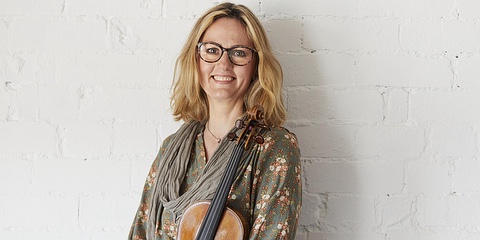
MCO’s Daybreak can be heard on Thursday 6 March 7:30pm and Sunday 9 March 2:30pm at Melbourne Recital Centre.
Under the guidance of artistic director Sophie Rowell, audiences have plenty to look forward to ahead of the Melbourne Chamber Orchestra’s 2025 season.
With a new work from the MCO’s own Matt Laing, receiving its premiere performance in season-opening concert Daybreak, to a showcase of composers from across the globe, Sophie is bringing the MCO into a new year with much verve and vibrancy.
But this is to be expected of an artist raised in a musical household in which her two older brothers were playing instruments well before she was even born.
As Sophie reflects, “Music has always been part of my life. It got to the stage, after I’d left school, that I realised it was something I couldn’t do without. It was the major focus of my life and my work – and that certainly hasn’t dimmed. I still have the same passion for it, the same love of it, that I had right from the start.”
Looking back on her development as a musician, it’s hard to pinpoint an exact point at which Sophie believes she really came into her stride artistically. Ultimately, she identifies the Balmain Sinfonia Concerto Competition as the guiding light of her development as a professional musician, winning the award in 1997.
“That changed my trajectory as a violinist,” she recalls, “because I realised that I had something that people weren’t taking up. Playing Beethoven’s Violin Concerto at that time in my life transformed me from being somebody who wanted to play the violin, to somebody who wanted to play the violin well.”
Looking ahead to the MCO’s upcoming concerts, she expresses particular enthusiasm for This waking moment, the new piece written by Matt Laing.
“I’m delighted,” Sophie says. “It’s hearing one of our voices with a very unique compositional style. His intimate knowledge of the orchestra is really translated into the piece that he’s written for us.”
While also keenly anticipating the performance of George Walker’s Lyric for Strings, a short piece she feels says everything it needs to in such a concise presentation, Sophie admits that the piece closest to her heart is Ravel’s Petite Symphonie à cordes.
It’s a piece she has played numerous times, “as a string quartet player for twelve years,” and one that is well suited to the warmth and brightness of the MCO’s performance style.
When reflecting on why she prefers the smaller-scale nature of a chamber orchestra, compared to the grandiosity of the symphony orchestra, she highlights the intimate nature of the former and the effect this creates.
“The energy between the players, of every player on the stage,” she asserts, “is palpable for everyone in the audience. As an audience member, I feel like I’m more part of the performance when I can feasibly see that energy and the communication between the players.”
As opposed to the larger, more alienating sound of the bigger orchestra, this intimacy is what invites you in as the listener.
As Sophie says, “That invitation is a very special one, I think.”
See program notes.
Liam Heitmann-Ryce-LeMercier