


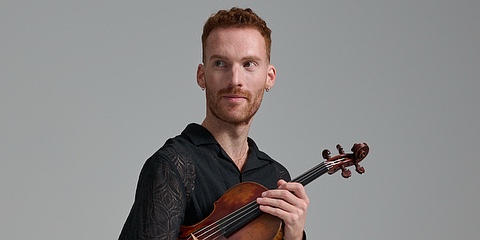
For many of our audiences, violinist James Armstrong will be a familiar face on stage, having appeared with MCO across a range of concerts in recent years. Whether in Melbourne or on tour through regional Victoria, audiences will have come to know his vibrant musicianship, warm presence, and the sense of energy he brings to the ensemble.
James’s relationship with music began early, but the violin arrived through an unexpected turning point. After first learning keyboard, clarinet and flute, he saw the acclaimed Australian documentary Mrs Carey’s Concert, which follows the life-changing power of school music-making and the dedication of an inspiring teacher. It was a moment that stayed with him. “That was where the obsession began,” he recalls. “I was so inspired by Emily Sun’s performance of Bruch’s Violin Concerto that I told my parents, ‘I want to do that.’”
The connection was immediate. “It felt right for me straight away,” he says. “My family would have to tell me to stop practising.” From there, his studies led him through the Sydney Conservatorium of Music and later to the Australian National Academy of Music in Melbourne, where he studied with MCO Artistic Director Sophie Rowell.
James first began performing with MCO through the ensemble’s Early Chair program, which supports musicians in the transition from study to professional life. Supported by the Arnold Foundation and the Julian Zahara Memorial Fund, the initiative helped provide an early pathway into the ensemble. He has since established himself as a valued and regular presence on our stage.
Since first performing with MCO in 2023, James’s connection with the ensemble has continued to deepen through concerts, touring, and the many shared moments that happen around performances. “It’s been wonderful for me to play different programs with MCO over the last few years and get to know the other players and the broader MCO community,” he says. “It’s beautiful to be a part of it.”
That sense of belonging extends to audiences as well. James speaks warmly of the connections formed both in the city and on the road. “My connection with the ensemble has also developed by getting to know our audiences, whether that’s in the regions or after our concerts at Melbourne Recital Centre with a glass of Narkoojee.” For him, these moments are part of what makes MCO distinctive: the feeling that music continues long after the final note.
When asked what stands out most about making music with MCO, James speaks first about culture. “There’s a strong sense of generosity in the group and the whole organisation,” he says. “That really comes across on stage and is reflected back to us from the audiences.”
He describes an environment shaped by generosity, respect, honesty, and engagement. “Those values make MCO a happy and exciting place to be making music,” he reflects.
That spirit comes sharply into focus in Overgrown Paths, led by Sophie Rowell from the violin and culminating in her performance as soloist in Vivaldi’s The Four Seasons. The program moves from the charm of Hugo Wolf’s Italian Serenade, through Libby Croad’s Portraits and Janáček’s On an Overgrown Path, before arriving at one of the most beloved works in the repertoire.
James is especially drawn to the contrasts within the program. “I’ve played Wolf’s Italian Serenade a couple of times. It’s so charming and virtuosic and a great way to start a concert,” he says. “I was only familiar with Janáček’s On an Overgrown Path as a piano work, and this version captures the notion of memories beautifully. Then of course, Vivaldi’s Four Seasons is so timeless, and I’m really looking forward to hearing Sophie’s take on it.”
For James, chamber music offers a special kind of immediacy. “Chamber music makes me feel more connected with other musicians,” he says. “It’s about being in the moment together. There’s so much freedom and spontaneity that comes from the way we breathe and move together, listening and trusting each other and the music.”
That sense of trust and responsiveness is part of what audiences feel in performance: musicians listening closely, reacting instinctively, and shaping something together in real time.
For James, one of the most transformative parts of performance arrives when audiences enter the room. “What people might not realise is how different a space feels when you have an audience compared with rehearsal,” he says. “With an audience, the room comes to life and there’s a buzz in the atmosphere. It’s very exciting.”
It is a fitting reflection from a musician that audiences have come to know well: that live performance is ultimately a shared experience, created in the moment, and made richer through connection over time.
By Dr Samuel Cairnduff