


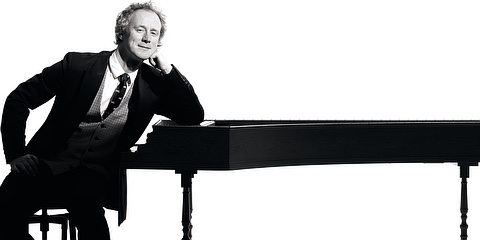
When Donald Nicolson sits at the harpsichord to lead the Melbourne Chamber Orchestra in Nightingale, he steps into a centuries-old tradition and renews it. “Gone are the days when the harpsichordist sat at the back behind the strings,” he says. “From the front, I’m in full contact with everyone. Bach and Handel directed this way, and that sense of conversation across the ensemble is something I absolutely love.”
That idea of dialogue runs through the entire program. When Artistic Director Sophie Rowell first invited Nicolson to collaborate, their instincts aligned: a Bach concerto, a Corelli Concerto Grosso, and works that explore myth and transformation. “The Ovidian story of the nightingale, Colin Brumby’s The Phoenix and the Turtle, and Melody Eötvös’s The Apollo all connect through mythology,” he explains. “You’ve got tragedy, rebirth, wit and splendour, a tapestry of eras speaking to each other.”
At the heart of Nightingale is Bach’s Harpsichord Concerto No 1 in D minor BWV1052, a work that Nicolson first performed after only three weeks of harpsichord study. “It’s still extraordinary to me,” he says. “Bach essentially invented the harpsichord concerto. He found such diversity of colour and emotion in an instrument that people assumed was limited. Every time I play it, I’m astonished anew. It explores everything about the instrument, from brilliance and drive to moments of real tenderness.”
Directing from the keyboard also transforms the rehearsal dynamic. With no separate conductor, MCO’s chamber scale demands focus, empathy and trust. “It’s true chamber music,” Nicolson says. “Everyone has greater responsibility and every line matters. That collaboration is what gives MCO its warmth and unity. In rehearsal, I love taking time to strip back textures and listen to how the inner voices and continuo lines speak to each other. When everyone contributes equally, the music breathes differently.”
Improvisation also plays an important part in Nicolson’s approach to Bach. “One of the joys of the harpsichord is exploring freedom within structure,” he says. “Bach was an extraordinary improviser. In the slow movements, I like to find space to let the line wander, to weave around the pulse, to surprise the ear. That spontaneity brings the music to life for both performer and audience.”
For Nicolson, the combination of Baroque and modern works in Nightingale reveals the instrument’s continuing evolution. “People still think of the harpsichord as an old instrument,” he says, “but Melody’s new piece reminds us it’s alive and evolving. Her The Apollo sits perfectly with Bach and Brumby. Each explores order, imagination and myth in a different language. It’s a dialogue across time that shows how expressive the instrument can be.”
Nicolson describes Nightingale as an emotional journey that bridges centuries. “Seventeenth-century composers talked about moving the passions,” he reflects. “They wanted to stir the heart, not just impress the mind. That’s what I hope Nightingale will do, to lift spirits, to make people feel and to remind us that music’s emotional power transcends time.”
By Dr Samuel Cairnduff