


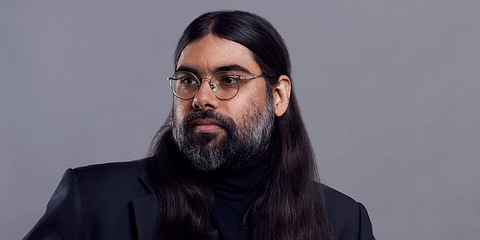
MCO’s Under the Canopy can be heard on Thursday 9 July 7:30pm at Melbourne Recital Centre; Friday 10 July 7:00pm at Her Majesty’s Theatre; Saturday 11 July 7:30pm at Wyndham Cultural Centre; and Sunday 12 July 2:30pm at Melbourne Recital Centre.
JEAN-PHILIPPE RAMEAU
Suite from Six Concerts En Sextuor (arr string orchestra Stanisław Skrowaczewski)
Jean-Philippe Rameau (1683–1764) has been described as one of the greatest figures in French musical history, a theorist of European stature and France’s leading 18th-century composer.
The Six Concerts En Sextuor was not published in Rameau’s lifetime and consists of works from the earlier Pièces and three from the Nouvelles suites de pièces de clavecin. The Pièces de clavecin en concerts collection was published in 1741and grouped into five concerts of three or four movements.
The individual works in the collection are mostly identified and named as a place, a character or a person. The movements performed include: La Pantomime, an expressive account of the storytelling art of a mime; La Forqueray, a fugal tribute to the French virtuoso of the viola da gamba, Antoine Forqueray; L’Enharmonique (or enharmonic), a theoretical debate on tonality and temperament, with the movement marked gracieusement (to be played gracefully); La Cupis, a reflective and sensitive portrait of either the dancer Marie-Anne Cupis or the violinist Jean-Baptiste Cupis; and La Poule – the hen, featuring the clucking of a chicken as she struts amongst her coop-mates.
The arranger Stanisław Skrowaczewski (1923-2017) was an American conductor and composer of Polish birth. His 1969 arrangement for string orchestra uses pieces from the comprehensive 1895 edition by Camille Saint-Saëns.
CARL PHILIPP EMANUEL BACH
Harpsichord Concerto in A major Wq29 (H437) (arr Crabb)
Carl Philipp Emanuel Bach (1714-1788), the second surviving son of Johann Sebastian Bach and his first wife Maria Barbara, was an important and influential composer of the second half of the eighteenth century, composing more than 1000 works including songs, oratorios, keyboard dance movements and sonatas, concertos and symphonies.
He composed over 50 keyboard concertos, with many written after 1730 and widely distributed over the time. He placed equal importance on the soloist and the orchestra, producing an incredible mixing of themes and the development of ideas. The concertos follow the standard fast-slow-fast model that he developed in his symphonies. The concertos use the ritornello form in a masterly manner. The A major concerto was composed in 1753.
AARON WYATT
Under the Canopy* (new arrangement)
Aaron Wyatt (b 1983) is a violist, violinist, conductor, composer, programmer, and academic. Originally from Perth, he spent many years as a regular casual with the West Australian Symphony Orchestra before moving to Melbourne to take up an assistant lecturer position at Monash. A member of the Decibel New Music ensemble, he also develops their animated graphic notation app, the Decibel corePlayer. In 2021 he became the first Indigenous Australian to conduct a state symphony orchestra in concert, and as a composer he has written both traditional and electro-acoustic works for ensembles like Decibel, Grey Wing, Ensemble Dutala, Ensemble Offspring, the West Australian Symphony Orchestra, and the Monash Academy Orchestra.
About Under the Canopy, he writes: “So often when people think of the Australian landscape, they think of a sparse and unforgiving terrain. Under the Canopy instead reflects on the forests near where I have lived in the more southern reaches of the country: the temperate rainforests around Melbourne, and the mighty Jarrah and Karri forests of the southwest.”
TOMÁS GUBITSCH
In a tango state of mind
Tomás Gubitsch (b 1957) is an Argentine guitarist, composer, and conductor. Described as having a precocious talent as a rock virtuoso in his youth, his later career has included composing film music and contemporary chamber works in Europe. He is renowned for his collaborative work with performances blending classical, rock, and world music influences, while reflecting his Argentine background and international connections.
In a tango state of mind is a concerto for accordion and string orchestra. It was composed and premiered in 2011 in Växjö, Sweden. The three contrasting movements draw us into such a simple yet intricate compositional landscape in which we hear influence of past collaborations and future directions.
SCOTTISH TRADITIONAL
Selections (arr Crabb)
A remarkable collection, the Scottish Traditional works draw on different lives and take inspiration from so many guises. These arrangements by James Crabb transport us to another time and world.
Friedemann Stickle’s (1794–1867) Da Trowie Burn takes us to a small stream in the parish of Tingwall on the Shetland islands. Stickle was a legendary fiddler who came from Germany and settled on the Shetland island of Unst. This slow jig is a Scottish classic and acknowledges the Trows, which are Shetland’s faeries or little folk.
James Scott Skinner (1843–1927) was an influential Scottish composer, violinist and dancing teacher and lived near Aberdeen but travelled widely. He composed more than 600 tunes. The elegy Ossian composed around 1904 for violin and piano, is subtitled “There is a joy in grief.” Ossian was the Gaelic warrior-poet.
The Scottish fiddler and composer Niel Gow (1727–1807) composed the Lament for the Death of his Second Wife of thirty years, Margaret Urquhart of Perth. This is considered by some as one the loveliest tunes ever written, being full of tenderness, and grace, and beauty. What a beautiful tribute and memory!
The traditional Struan Robertson’s Rant (also known as Cuckold Come Out of the Amrey) is a reference to Struan (or Streamy) as a placename in Perthshire, a region known for its harpers in the 17th century whose chiefs were referred to as the Struan Robertsons. This is a fast reel with extended variations.
By David Forrest