


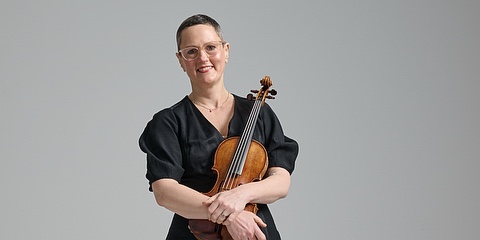
Well known to our audiences as the central artistic voice within the ensemble, Sophie now steps into the spotlight as soloist in Vivaldi’s The Four Seasons. One of the most beloved works in the repertoire, its return here feels both like a homecoming and a reimagining.
For Sophie, the starting point was not simply to revisit a familiar masterpiece, but to hear it differently. “I’ve always been drawn to the way different art forms speak to and shape one another,” she says. “Music is influenced by art, architecture, literature and dance, and in turn, it feeds back into those worlds.”
At the centre of that idea sits the work itself, capturing both the natural world and the emotional landscapes we inhabit. In Overgrown Paths, it becomes the anchor for a broader reflection on how music can mirror, deepen, and extend those experiences, not by presenting the familiar as fixed, but by opening it up.
That sense of renewal is central to Sophie’s relationship with the work. “I never tire of these concertos,” she says. “There is always something new. No two birds in Spring ever sound quite the same, and Summer builds with an almost intoxicating intensity.”
For Sophie, the enduring appeal of The Four Seasons lies precisely in its openness. Each performance becomes an act of rediscovery, shaped in the moment and responsive to the musicians who bring it to life.
That process of reimagining is deepened through the interplay between music and text. “Bringing poetry into a concert feels completely natural,” Sophie reflects. “It adds another layer to that exchange by giving voice to something that is often felt but unspoken.”
Across the program, spoken word does not sit alongside the music, but within it, shaping how it is heard and understood.
The presence of acclaimed actor Helen Morse is central to that approach. Performing Vivaldi’s original sonnets alongside The Four Seasons, she brings language to the forefront of a work audiences often experience purely as sound. “As violinists, we grow up with these texts in the score,” Sophie says, “but they’re not often brought into the live performance experience. To have an actor of Helen’s calibre give voice to these words adds an entirely new dimension.”
In doing so, the familiar becomes newly immediate, its imagery sharpened and its drama brought closer to the surface.
Across the wider program, that same dialogue continues. Libby Croad’s Portraits, paired with poetry by Eleanor Percy, deepens the relationship between text and sound, while works by Wolf and Janáček expand the emotional arc. “The words can sharpen an image or suggest a direction,” Sophie explains, “and the music then expands that emotional world. It becomes a dialogue, not just between art forms, but between performer and listener.”
That sense of dialogue is equally present within the ensemble itself. Leading from the violin while stepping forward as soloist, Sophie describes the orchestra as a constantly shifting, responsive organism. “A chamber orchestra is such a responsive organism,” she says. “Every individual contributes to the energy and spirit of the performance. It’s a true musical conversation, where every voice matters.”
Leadership, in this context, emerges through listening, responding, and shaping in real time.
“In both roles, I feel I’m part of a continuous exchange,” she reflects. “By turns I am guiding and responding, shaping and being shaped.”
It is this balance, and this shared sense of discovery, that gives the performance its immediacy and vitality.
Ultimately, Overgrown Paths returns to the idea that first set it in motion: connection. Between music and words, between performers, and between the stage and the audience. “My hope is that the exchange won’t stop at the edge of the stage,” Sophie says. “That it extends to everyone in the audience. That is what brings the music to life.”
Anchored by the enduring beauty of The Four Seasons and enriched by poetry and narration, the program invites audiences into a shared experience of reflection, atmosphere and emotional connection.
By Dr Samuel Cairnduff